
In this article
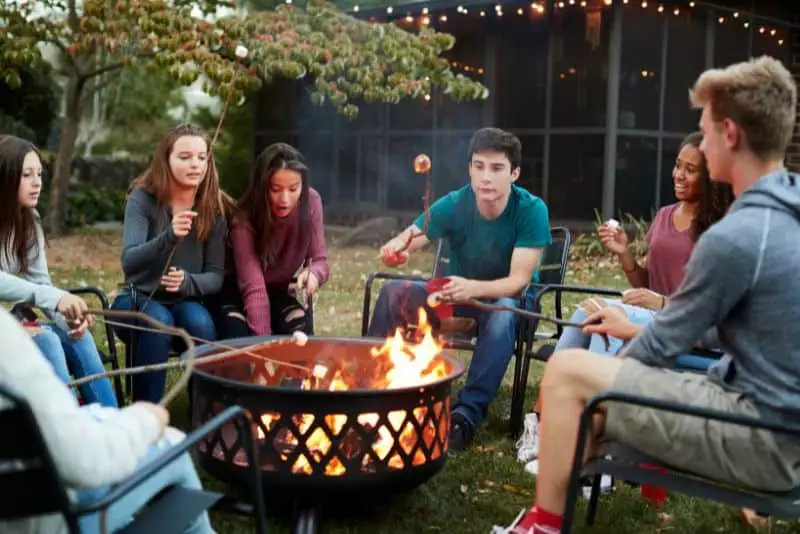
Yes, you can roast marshmallows on a propane fire pit. Marshmallows are close to the only food that belongs over one, because they are dry and they do not drip. Nearly every gas fire pit is sold as a decorative appliance, and the manual almost certainly tells you not to cook on it, but a marshmallow on a skewer held above the flame is not the thing that manual is worried about. Follow a few basic rules and you can toast a thousand of them without hurting the pit.
Below: why the warning is in the manual at all, what to use, how to get the marshmallow right, and the one situation where I would not roast anything over a gas pit.
Why the manual says not to cook on it

Propane fire pits are not tested as cooking appliances the way gas grills are. That is the whole of it. A grill goes through food-contact and cooking testing; a fire pit is certified as a heater and a decoration.
The rest is liability. If a manufacturer does not spell out what you should not do with a product, they are exposed when somebody does something creative with it and gets hurt. So the manual says no cooking, full stop, rather than trying to draw a line between a marshmallow and a rack of ribs.
That does not mean ignore the warning entirely. It means read it for what it is. Roasting marshmallows is fine. Cooking actual food over the pit is genuinely a bad idea, and I will get to why.
What you need
Before the first roasting session, run the pit a few times on its own. A new pit burns off whatever it picked up in the factory and the box, and you would rather that happen with nothing over the flame. Check that the fire glass or lava rock is clean while you are at it.
For the skewer, get one with at least two prongs. A single prong lets the marshmallow spin loose and drop into the media, which is the one mistake that actually costs you something.
Telescoping roasting sticks
These two-prong telescoping sticks extend to 32 inches and come as a pack of 12 with a carrying bag. Twelve is more than most families need, but it means nobody is waiting for a stick, and the long reach keeps hands well back from a wide fire table. I have not used this set myself; it is here because the two prongs and the length are the two things that matter.

Retractable roasting sticks
If you want a set that packs down small, these retractable roasting sticks retract to 9.4 inches and extend to 33.9. They are stainless steel with double prongs and insulated handles, and they come as a set of 4 with a carrying bag. The points are sharp, so they are not a substitute for an adult standing there.

How to roast the marshmallow

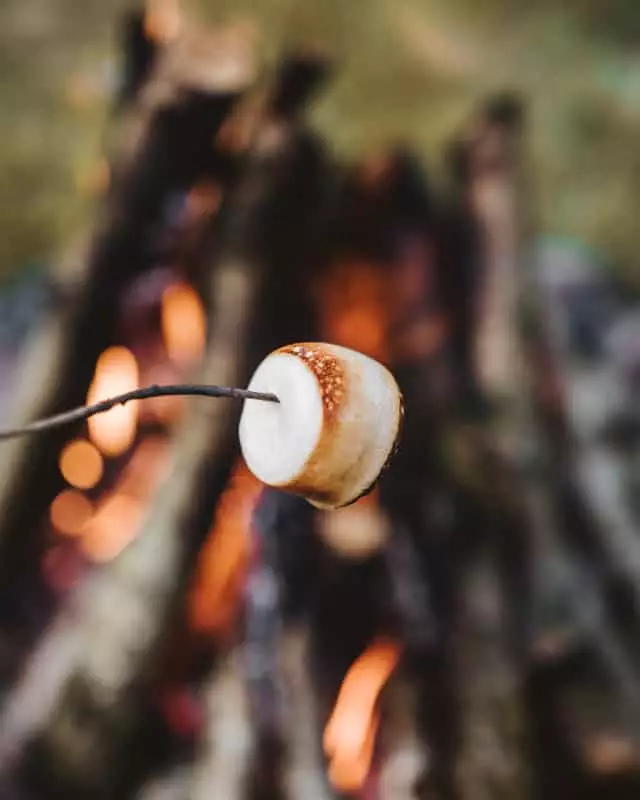
I want a crisp shell and a molten middle, without the black. Here is the method that gets me there:
- Slide one marshmallow onto the prongs until about a quarter inch of tip shows through the other side. That extra bit is what stops it sliding off when it softens.
- Find a spot with steady flame. On a propane pit that is easy, since the flame does not wander the way a wood fire does.
- Hold it about an inch above the flame and turn it slowly so every side gets the same heat.
- When it goes pale golden, drop it straight into the flame for one or two quick rotations. Two or three seconds, no more. That is what gives you the crisp shell.
- Let it cool for a moment, then eat it off the stick or press it between chocolate and graham crackers. Peanut butter in the s’more is worth trying once.
I still burn one now and then by leaving it in the flame a beat too long. A little carbon occasionally is not going to shorten anyone’s life much, and honestly it was worth it. If you want the healthier version, stop at golden.
Cleaning up afterward
Turning the knob puts the fire out, which is the whole appeal of propane. The cleanup is about the media underneath.
The black film
Burning propane leaves a dark film on fire glass and lava rock. It is normal and it is not a problem, just soot. Dark fire glass hides it better than clear, but either way it is worth rinsing the media occasionally. On lava rock the soot barely shows at all.
Washing the media
Wear gloves. Broken fire glass has edges, and lava rock is abrasive.
- Take the media out of the pit.
- Work in batches, a colander at a time.
- Rinse under a tap or hose.
- Add a little dish soap and work it through with your hands.
- Rinse the suds off and spread everything on a towel to dry.
Make sure it is completely dry before you light the pit again. Moisture trapped in a cracked piece of glass or a porous rock can expand fast enough to burst it. It is rare, but drying properly costs you nothing. The same physics is why pea gravel is a bad idea in a fire pit.
What to do if you drop a marshmallow in
It will happen eventually. Deal with it that evening if you can, because once melted sugar cools and hardens onto fire glass or lava rock it is not really coming off.
Let the pieces cool first. Fire glass holds heat noticeably longer than lava rock does. For fire glass, soaking the affected pieces in a vinegar and baking soda solution before washing them is worth a try; if the marshmallow sat in the flame for more than a couple of minutes, just replace those pieces. For lava rock, do not bother trying. All those pits and holes make it a losing fight. Toss the affected rocks and top the pit back up.
Do not cook anything else on it
This is where the manual has a point. Meat and vegetables drip. Those juices work down through the media and into the burner holes, and clogged burner holes turn into an uneven flame or a pit that will not light. Food residue in the media also attracts rodents and insects, and those chew on wires and gas lines.
Marshmallows work precisely because they have almost no moisture to give up. If you want to cook over a fire, that is what a wood pit is for, which is one of the real differences in the wood versus gas comparison.
When I would skip it
Roasting over propane is safe in the ordinary case. The thing to think about is what the heat touches on its way to the marshmallow.
The media is the main one. Lava rock and fire glass are both inert and fine. What I would check is whether your particular media has been coated or treated with anything, which is not standard practice as far as I know, but the packaging will tell you. If the bag does not say, or it is decorative landscaping rock rather than fire pit media, roast somewhere else.
Same logic for the pit itself. Manufacturers use different materials, and none of them were tested for food contact, because the pit was never meant to be cooked over. Also worth knowing: if something food related does damage your pit, the warranty is not going to cover it.
Basic fire sense applies as always. An adult stays with the fire, kids stay back from the rim, and nobody swings a hot skewer around. The rest of the ground rules are in the fire pit safety guide.
Questions people ask
Do marshmallows taste different over propane?
Propane burns cleaner than wood, so if anything you are less likely to get an off taste. It is the same gas that feeds a propane grill and it does not leave a chemical flavor.
Can you roast marshmallows over lava rocks?
Yes. Plenty of gas grills use lava rock to spread heat under the grates. Fire glass works the same way and is equally fine to roast over.
Can you make s’mores on a propane fire pit?
Yes, and it is the main reason to roast in the first place. Assemble them away from the pit so the chocolate does not end up in the media.
Are burnt marshmallows bad for you?
A charred marshmallow now and then is unlikely to matter much, though golden is the better target for taste as well as anything else. I am not a doctor and this is not medical advice.